An AV receiver is the backbone of any home theater, much like a skilled chef is to a fine dining experience. With numerous options available, choosing the right one can be daunting. If you’re in the market for an NAD amplifier, understanding the evolution of NAD receiver models over the years is key.
This guide will walk you through the various NAD receiver models by year. It will help you make an informed decision that suits your home theater needs. By exploring NAD’s receiver history and technology, you’ll find the perfect receiver for your setup.
Key Takeaways
- Understanding the importance of AV receivers in home theaters.
- Overview of NAD’s receiver history and model evolution.
- Key factors to consider when choosing an NAD amplifier.
- Insights into the advancements in NAD receiver technology.
- Guidance on selecting the right NAD receiver for your home theater.
The Legacy of NAD in Audio Excellence
NAD has a long and impressive history in audio equipment. For decades, they’ve been making high-quality audio products. These products meet the changing needs of music lovers.
NAD’s Philosophy and Approach to Sound
NAD believes great sound is more than just numbers. It’s about feeling the music. Their sound is clear, detailed, and natural. This makes their receivers offer a deep listening experience. By focusing on the nuances of sound, NAD products connect with music fans.
Why NAD Receivers Stand Out in the Market
NAD receivers are known for their top-notch sound, solid build, and new features. They stand out because of their power and performance. Their receivers work well with many speakers, fitting different listening spaces. They also use BluOS and Dirac Live Room Correction to improve sound quality. This makes them popular among both music lovers and home theater fans.
| Feature | NAD Receivers | Competitor Receivers |
|---|---|---|
| Sound Quality | Exceptional clarity and detail | Varies by brand |
| Build Quality | Robust and durable | Often less robust |
| Innovative Features | BluOS, Dirac Live Room Correction | Limited advanced features |
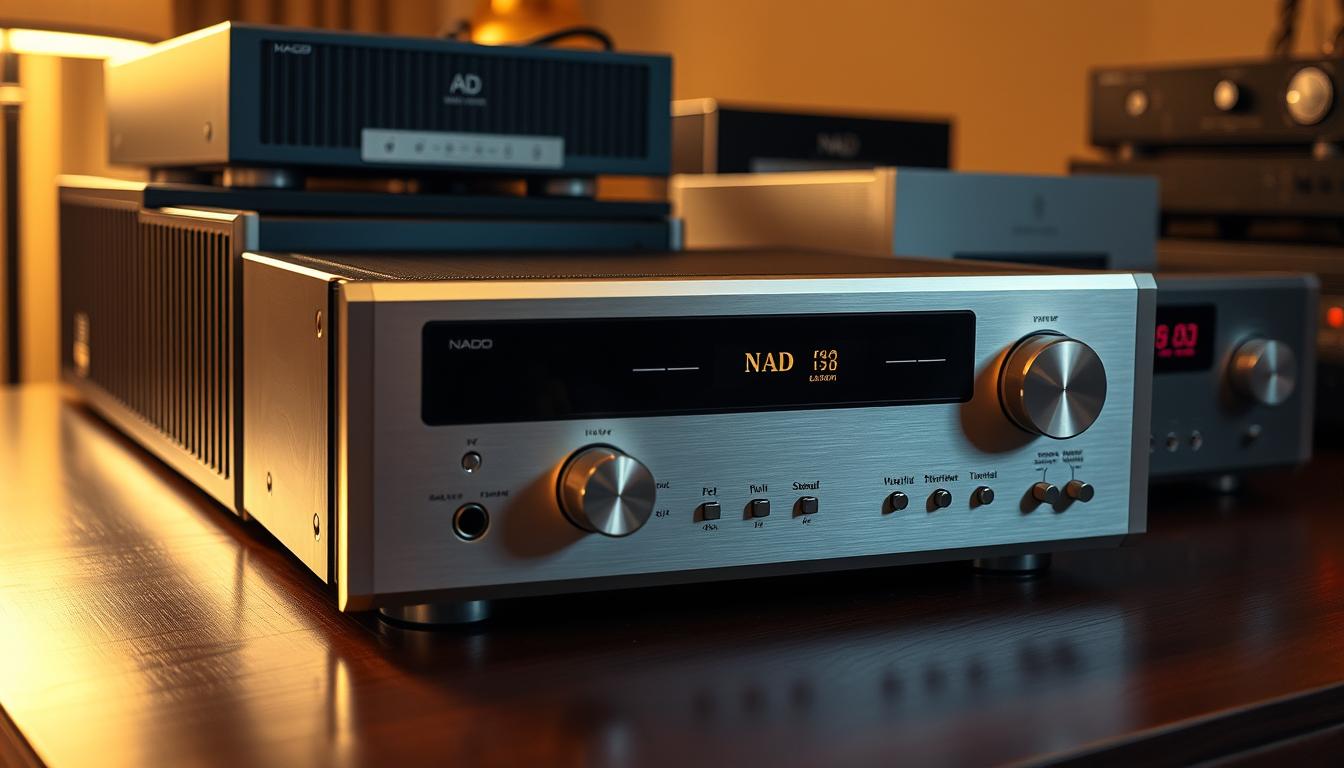
Understanding NAD Receiver Model Numbers
When picking a NAD receiver, knowing the model numbers is key. These numbers tell you about the receiver’s features and its place in the lineup. It’s not just a series of digits.
Decoding NAD’s Naming Conventions
NAD’s model numbers have a special meaning. They start with a letter or letters that show the product type. For example, “T” means home theater, and “C” means integrated amplifiers. The numbers after that show the model’s level, with higher numbers meaning more features or better performance.
Series Designations and Their Significance
NAD’s series names give you more insight. The “7000” series, for instance, is known for top-notch receivers with advanced tech. Knowing these series can help you find the right receiver for your needs and budget.
| Model Prefix | Product Category | Series Designation | Performance Level |
|---|---|---|---|
| T | Home Theater Receiver | 7000 | High-End |
| C | Integrated Amplifier | 300 | Mid-Range |
| M | BluOS Streaming Amplifier | 30 | Entry-Level |

Understanding NAD’s model numbers and series designations helps you choose the right receiver. It ensures you get one that meets your audio needs.
NAD Receiver Models By Year: A Comprehensive Timeline
NAD has been making receivers for years, each one special in its own way. Looking at NAD’s timeline helps us understand how the brand grew and innovated.
Evolution of NAD’s Design Philosophy
NAD’s design ideas have changed a lot over time. At first, they aimed for simple, high-quality designs that focused on sound. Later, they added new features like digital signal processing and home theater integration.
This mix of old values and new tech has kept NAD at the top of the audio world. They’ve always been about high-quality audio and innovative technology.
Key Technological Milestones
NAD has hit many tech milestones, changing their receivers a lot. For example, they introduced Power Envelope Technology to make sound quality better at lower power. They also added digital signal processing for better audio control.
Other big steps include home theater integration, modular designs, and BluOS streaming tech. These changes have made NAD receivers better and more flexible for users.
The 1970s: NAD’s Foundational Years
The 1970s were a key time for NAD. They launched several amplifiers that became classics in high-fidelity audio. This decade helped NAD build a strong reputation for quality audio equipment.
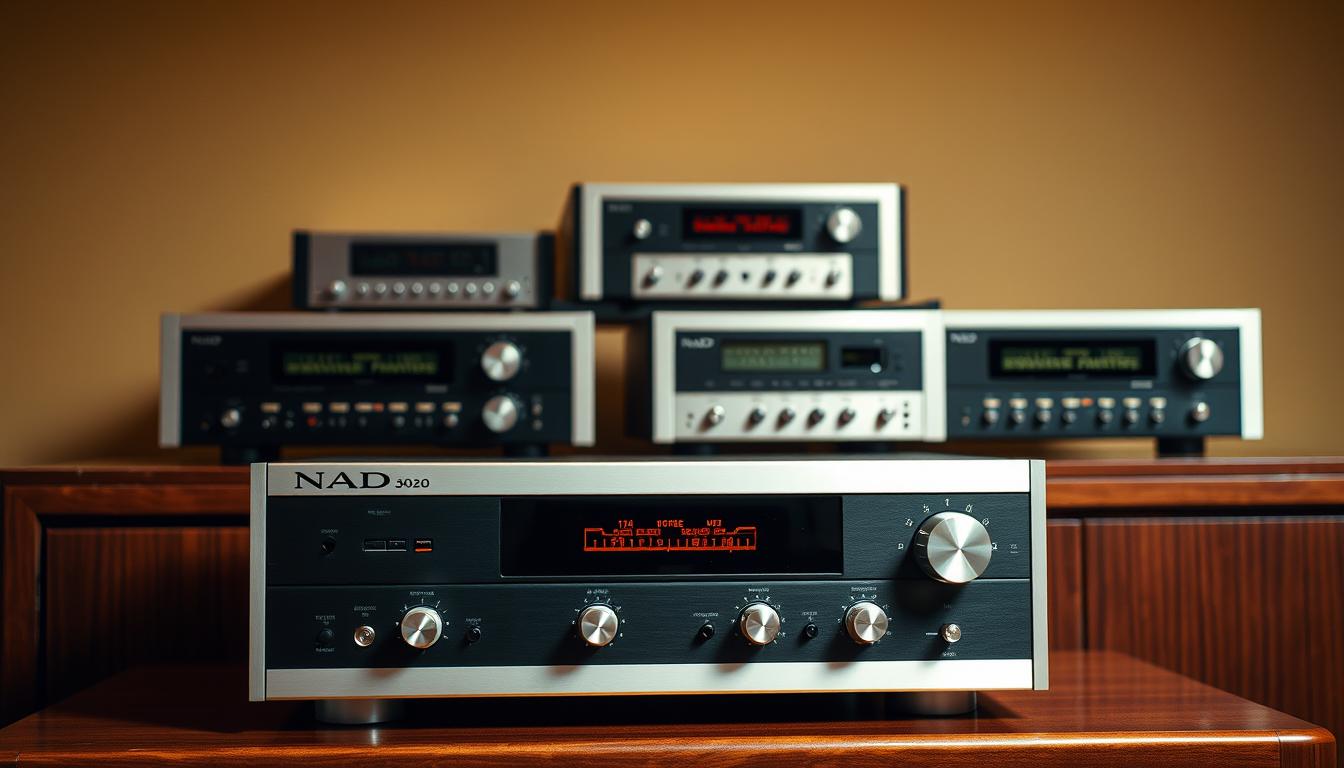
The Iconic NAD3020 Integrated Amplifier
The NAD3020 integrated amplifier is a standout from NAD’s early days. Released in the late 1970s, it quickly won over audiophiles. It was known for its clear sound and durable build.
It was praised for its high performance at a good price. This made it a favorite in many home audio setups.
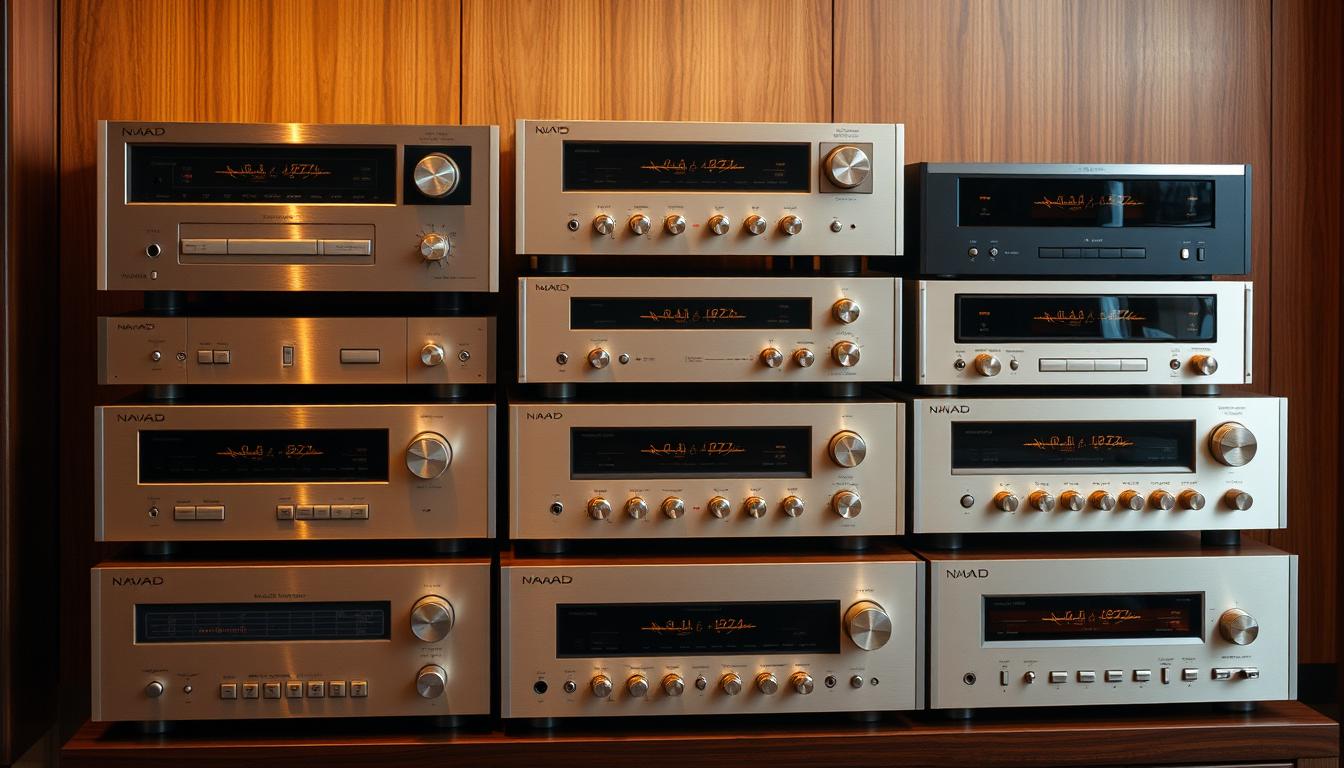
Other Notable 1970s Models: 7020, 7040
Other notable models from the 1970s include the 7020 and 7040 amplifiers. These models kept up NAD’s tradition of quality sound and design. The 7020 was small but powerful, while the 7040 had advanced features and top-notch sound.
| Model | Year Released | Notable Features |
|---|---|---|
| NAD3020 | 1978 | Clear sound, robust build |
| NAD7020 | 1977 | Compact design, powerful output |
| NAD7040 | 1979 | Advanced features, superior sound quality |
NAD’s focus on quality and innovation in the 1970s paved the way for their success. The models from this time showed NAD’s commitment to high-performance audio at a fair price. They also raised the bar in the industry.
The 1980s: Expansion and Innovation
The 1980s were a big time for NAD. It was a decade of growth and new tech. Many new receiver models were introduced, making NAD a top name in audio.
The Monitor Series Revolution
The Monitor Series, with models like the 7155 and 7175, changed how NAD made receivers. These models were known for their high-quality sound reproduction and robust build quality. They marked a big step for NAD, bringing better sound to listeners.
An audio expert said, “The NAD 7155 and 7175 set a new standard for audio performance. They offered detail and clarity like never before.” This shows how much the Monitor Series impacted the audio world.
Power Envelope Technology and 7240PE, 7100 Models
NAD also brought in Power Envelope Technology in the 7240PE and 7100. This tech made power delivery more efficient. It led to improved dynamic range and better overall performance. The 7240PE became famous for its power and flexibility.
| Model | Key Features | Significance |
|---|---|---|
| 7155 | High-quality sound reproduction, robust build | Set new standards for audio performance |
| 7175 | Advanced receiver design, high fidelity | Enhanced NAD’s reputation for quality |
| 7240PE | Power Envelope Technology, dynamic range | Iconic model for its power and versatility |
The 1980s were key for NAD. The Monitor Series and Power Envelope Technology were big wins. They helped NAD keep its high standards and offer top-notch receivers to music lovers.
The 1990s: Digital Integration Era
The 1990s were a big change for NAD, with digital signal processing becoming key. This decade saw NAD start using digital tech in their receivers.
Introduction of Digital Processing: 705, 710 Receivers
NAD introduced digital processing in their receivers with models like the 705 and 710. These receivers offered improved sound quality and advanced features. They were known for processing digital signals, a big step up from analog.
The AV711, AV716 and Home Theater Integration
The AV711 and AV716 were big steps for NAD, diving into home theater. These AV receivers had multi-channel support and advanced surround sound processing. They were perfect for home theaters, aiming to give a full audio experience.
The 1990s were a key time for NAD’s growth. They led the audio industry with digital and home theater tech. If you’re looking for an NAD receiver, knowing the differences between models like the 705, 710, AV711, and AV716 helps choose the best NAD receivers for you.
The 2000s: Home Theater Revolution
The 2000s marked a big change with NAD leading the home theater revolution. They introduced new AV receivers that changed how we enjoy entertainment at home.
T753, T763, T775 AV Receivers
NAD’s T753, T763, and T775 AV receivers were top choices in the 2000s. They offered advanced features and top-notch sound quality. The T753 was known for its strong power and many connection options.
The T763 improved on this with better Dolby Digital and DTS decoding. The T775 was the best of NAD’s home theater tech. It had full surround sound and lots of input/output options.
Modular Design Approach and Upgradability
NAD’s design allowed for easy upgrades, making their receivers last longer. This made it cheaper to keep up with new tech. It showed NAD’s focus on innovation and customer happiness.
| Model | Power Output | Key Features |
|---|---|---|
| T753 | 100W per channel | Versatile connectivity, robust power |
| T763 | 120W per channel | Enhanced Dolby Digital and DTS decoding |
| T775 | 140W per channel | Comprehensive surround sound processing, extensive I/O |
NAD’s focus on modularity and upgradability showed their commitment to quality. Models like the T753, T763, and T775 are loved by many.
The 2010s: Network Integration and Streaming
In the 2010s, NAD introduced new network integration and streaming technologies. This decade was key for NAD, showing a big change towards making their receivers more connected and versatile.
BluOS Platform Introduction: T758, T777
The BluOS platform was a big change for NAD. It made their receivers better for streaming and network integration. The T758 and T777 showed this off, making listening easier and more fun.
- Easy integration with various streaming services
- Multi-room audio capabilities
- Simplified control through mobile apps
The T758 and T777 were all about high-quality sound and modern streaming. NAD really showed they care about both.
C368, C388 Hybrid Digital DAC Amplifiers
NAD also improved with their hybrid digital DAC amplifiers, like the C368 and C388. These amplifiers mixed analog and digital, giving:
- High-quality digital-to-analog conversion
- Robust amplification for a wide range of speakers
- Flexibility in connectivity options
The C368 and C388 were made for both audiophiles and those who want modern features. They aimed to give great sound and flexibility for different setups.
In summary, NAD’s work in the 2010s, like BluOS and hybrid DAC amplifiers, put them at the top of the audio world. These innovations keep NAD’s receivers popular and respected among audio fans.
Current NAD Receiver Lineup (2023-2024)
In 2023-2024, NAD is leading the way in audio excellence with its latest receivers. These models meet a wide range of audio needs. They’re perfect for both home theaters and enjoying high-fidelity music.
T778 Reference AV Receiver
The T778 Reference AV Receiver is NAD’s top model. It’s all about delivering top-notch audio. It supports advanced Dolby Atmos and DTS:X processing for an immersive sound experience.
It has 7.2 channels and 150W per channel. It also supports 4K video pass-through. Plus, it includes Dirac Live room correction for the best sound in any room.
C399 Hybrid Digital DAC Amplifier
The C399 Hybrid Digital DAC Amplifier mixes old-school analog with new digital tech. This combo brings exceptional sound clarity and detail. It’s a dream for audiophiles who want the best from their music.
It’s got high-resolution audio support and NAD’s proprietary HybridDigital technology. It also has USB, coaxial, and optical inputs for flexibility in any setup.
M33 BluOS Streaming Amplifier
The M33 BluOS Streaming Amplifier is great for both streaming and amplifying music. It uses BluOS streaming technology for easy access to music services. It’s perfect for those who want a simple yet powerful audio solution.
It has high-quality analog circuitry and supports high-resolution audio playback. With Wi-Fi and Ethernet, it’s easy to connect to different networks.
| Model | Key Features | Power Output |
|---|---|---|
| T778 | Dolby Atmos, DTS:X, Dirac Live | 150W per channel |
| C399 | HybridDigital technology, High-resolution audio | 100W per channel |
| M33 | BluOS streaming, High-resolution audio | 120W per channel |
Vintage NAD Receivers: What to Look For
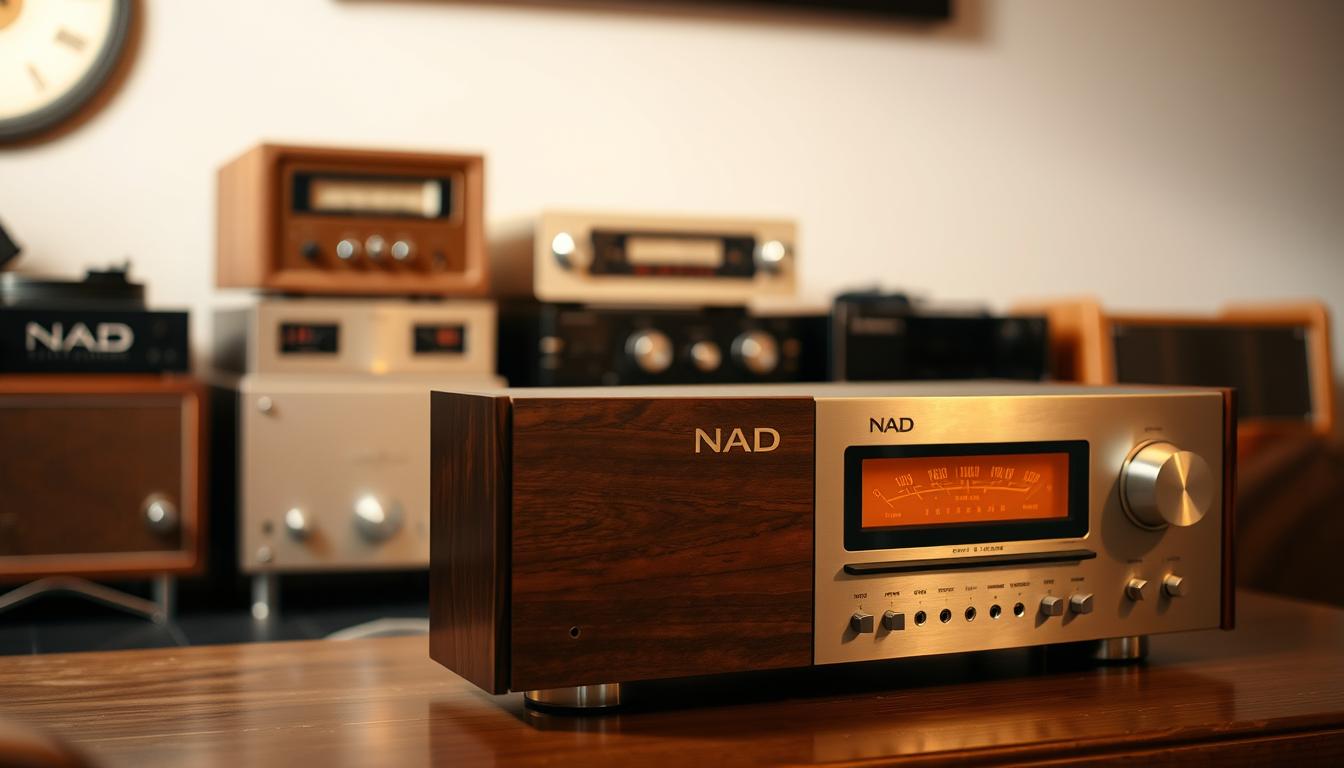
Vintage NAD receivers are loved for their great sound and history. They connect us to the past and offer top-notch audio quality. This makes them special for many music lovers.
Most Collectible NAD Models: 7240PE, 7600
The 7240PE and 7600 are top picks among vintage NAD fans. The 7240PE stands out for its Power Envelope tech, giving a lively sound. It’s known for its strong performance during complex music.
The 7600 is loved for its flexibility and solid build. If you’re interested in more, check out Marantz receiver models for a comparison.
Common Issues and Maintenance Tips
Vintage NAD receivers face issues like capacitor wear and old potentiometers. Keeping them in good shape is important. It’s wise to check and replace capacitors and clean potentiometers to avoid sound loss.
By doing this, your vintage NAD receiver will keep playing great music for a long time.
Comparing NAD Receivers Across Generations
Looking at NAD receivers through the years shows a journey of innovation. You’ll see big steps forward in sound quality and features.
Sound Signature Evolution: From Warm to Precise
NAD’s sound has changed a lot over time. Early models had a warm, analog sound that was loved by many. For example, the NAD 3020 was known for its rich sound.
As technology improved, NAD made its sound more precise and accurate. Now, their receivers offer a detailed listening experience. This is thanks to better digital processing and amplifier tech. Reviews of other brands show NAD has kept up well.

People now want sound that’s more accurate. “The pursuit of precision is not just about technical specs; it’s about creating an immersive experience,” say audio fans. Today, NAD’s receivers are perfect for those who love great sound.
Feature Set Progression: Analog to Digital
NAD receivers have changed a lot, moving from analog to digital. Early models were great for analog music lovers, with features like phono inputs. Later, they added Dolby Digital and DTS for better home theater sound.
Now, NAD receivers have advanced features like BluOS streaming and Dirac Live room correction. They also support 4K video pass-through. This shows how the industry has moved towards digital and smart home tech.
Today, NAD receivers have a wide range of features. They’re great for both simple stereo listening and complex home theaters. When choosing a NAD receiver, think about what features you need.
How to Choose the Right NAD Receiver for Your Needs
To get the best sound, pick an NAD receiver that fits your listening space and taste. With many models out there, knowing what you need is key to making a good choice.
Matching to Your Listening Environment
The size and setup of your room affect the right NAD receiver. Big rooms need more power to fill the space with sound. Think about your room’s acoustics, like echo and sound reflection, when picking a receiver.
- Smaller rooms might do well with a less powerful receiver, saving money and energy.
- Bigger rooms need receivers with more power and features for better sound distribution.
Considering Speaker Compatibility and Impedance
It’s important that your NAD receiver works well with your speakers. Make sure the receiver’s impedance matches your speakers’.
- Speakers with lower impedance (like 4 ohms) need receivers that can handle them.
- Higher impedance speakers (like 8 ohms) can work with more receivers, but check the specs.
Budget Considerations and Value Proposition
NAD receivers come in different prices, based on features, power, and tech. Set a budget and find a receiver that offers great value within it.
- Think about what features matter most to you, like 4K, Bluetooth, or Wi-Fi.
- Read NAD receiver reviews and compare models to find the best fit for your budget and needs.
By thinking about your room, speakers, and budget, you can pick the best NAD receiver for your audio setup.
Setting Up and Optimizing Your NAD Receiver
To get the most out of your NAD receiver, setting it up right is key. A well-set receiver can make your audio sound clear and strong.
Proper Placement and Ventilation
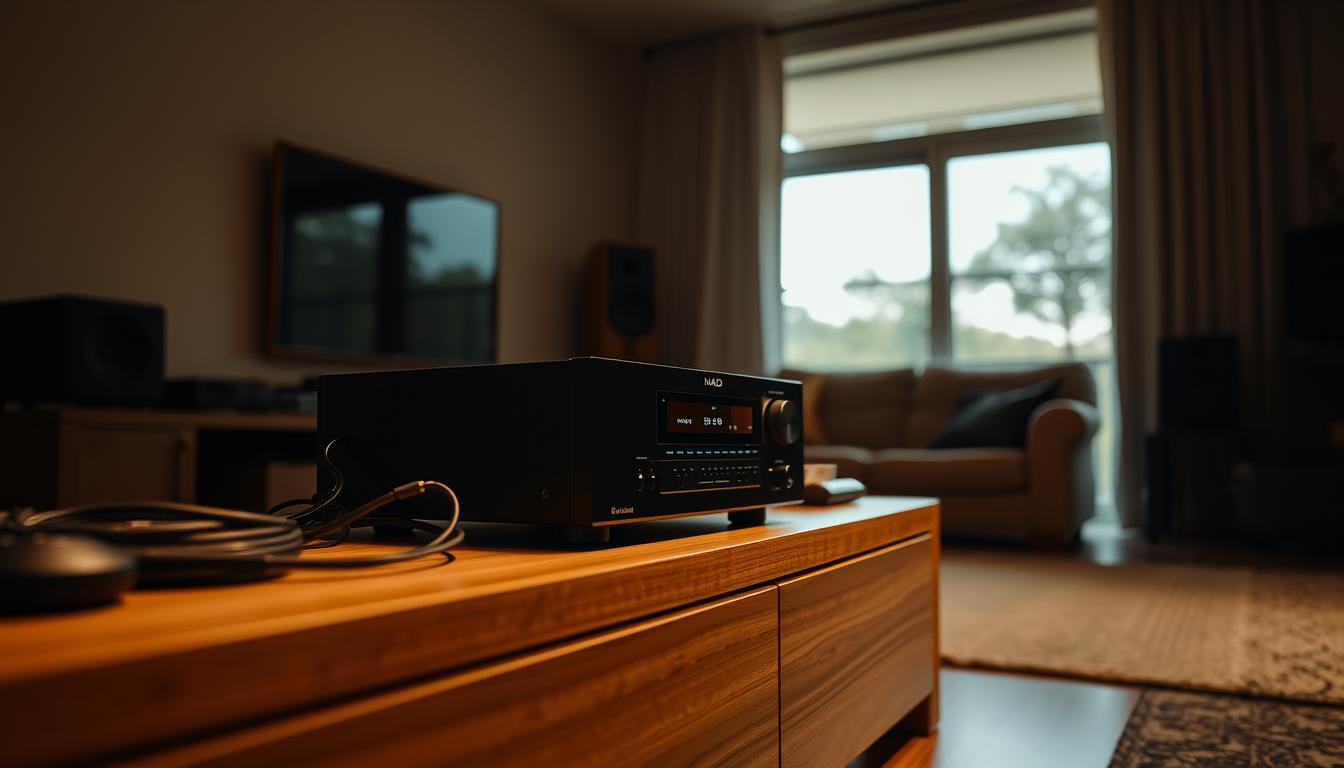
Where you put your NAD receiver matters a lot. It should be in a cool, airy spot to avoid overheating. Don’t put it in tight spaces or with other hot things. Make sure there’s 2-3 inches of space around it for air to flow.
Connection Best Practices
Connecting your devices right is important for the best sound. Use top-notch cables that fit your receiver’s needs. For example, use HDMI cables that support 4K if you have a 4K device. Label your cables so you can find them easily.
| Connection Type | Cable Recommendation |
|---|---|
| HDMI | High-Speed HDMI with Ethernet |
| Optical | TOSLINK Optical Cable |
| Analog | RCA or XLR, depending on your device |
Dirac Live Room Correction for Modern Models
Many NAD receivers have Dirac Live Room Correction. It makes your audio sound better in your room. To use it, download the Dirac Live app and follow the steps to set it up. This can really boost your audio quality by fixing your room’s sound issues.
By following these tips, you can make sure your NAD receiver sounds its best. It will be perfect for your space and needs.
NAD vs. Competitors: Comparative Analysis
NAD is a respected name in AV receivers. But Marantz, Cambridge Audio, and Denon also have their fans. Knowing how NAD stacks up against its rivals can help you choose the right AV receiver.
NAD vs. Marantz: Sound Character Differences
NAD and Marantz both offer top-notch sound. But they sound different. NAD receivers have a neutral sound, while Marantz gives a warmer, more dynamic sound.
The NAD T778 Reference AV Receiver is known for its precise sound. Marantz’s SR8015, on the other hand, has a bigger soundstage.
NAD vs. Cambridge Audio: Feature Comparison
NAD and Cambridge Audio differ in features. NAD receivers have advanced features like Dirac Live room correction and BluOS streaming. The NAD C399 Hybrid Digital DAC Amplifier is a great example.
Cambridge Audio focuses on high-quality audio with features like custom EQ settings. Your choice will depend on what you need and like.
NAD vs. Denon: Value Proposition
NAD and Denon both make high-quality AV receivers. But they offer different values. NAD receivers are known for their durability and value, like the NAD M33 BluOS Streaming Amplifier.
Denon receivers are also top-notch but might cost more for similar features. Your choice will depend on your budget and what features matter most to you.
Conclusion: The Enduring Appeal of NAD Receivers
NAD’s legacy in the world of audio excellence continues to captivate many. As we’ve explored, NAD receiver models by year have evolved a lot. They now have innovative features and technologies, making NAD a leader in the industry.
The history of NAD receivers is one of continuous innovation. From the iconic NAD 3020 integrated amplifier to the latest T778 Reference AV Receiver, NAD has always pushed the boundaries. Understanding NAD receiver history shows the brand’s dedication to quality and performance.
Whether you want vintage charm or the latest technology, NAD has it. The best NAD receivers offer great sound quality, features, and value. They are a smart choice for any audio enthusiast.
When thinking about your next audio purchase, remember NAD’s rich heritage and innovative spirit. With a NAD receiver, you’re not just buying a product. You’re investing in a legacy of audio excellence.
FAQ
What is the significance of NAD’s legacy in audio excellence?
NAD is known for its high-quality sound and innovative features. This makes it a favorite among audiophiles.
How do I decode NAD receiver model numbers?
To understand NAD receiver model numbers, learn the brand’s naming rules. This will help you know the model’s features and generation.
What are some iconic NAD receiver models from the 1970s?
The NAD 3020 integrated amplifier is a classic from the 1970s. It’s famous for its sound quality and durability.
What was the impact of the Monitor Series Revolution in the 1980s?
The Monitor Series Revolution introduced the 7155 and 7175. These receivers set a new standard for audio quality and features.
How did NAD integrate digital processing in the 1990s?
In the 1990s, NAD added digital processing to receivers like the 705 and 710. This upgrade improved their capabilities and led to future innovations.
What are the benefits of NAD’s modular design approach?
NAD’s modular design lets you upgrade or replace parts. This extends the life of your receiver.
What is the BluOS platform, and how does it enhance NAD receivers?
BluOS is a streaming technology that makes music streaming easy. It enhances the listening experience.
How do I choose the right NAD receiver for my needs?
To pick the right NAD receiver, think about your listening space, speakers, and budget. This ensures the best performance.
What are some common issues with vintage NAD receivers, and how can I maintain them?
Vintage NAD receivers can face issues like component wear. Regular cleaning and replacement can keep them working well.
How do NAD receivers compare to those from other brands like Marantz, Cambridge Audio, and Denon?
NAD receivers stand out for their unique sound and features. They offer a distinct listening experience compared to competitors.
What is Dirac Live Room Correction, and how does it enhance NAD receiver performance?
Dirac Live Room Correction optimizes sound for your listening space. It ensures accurate sound reproduction.
What are the key features of NAD’s current receiver lineup?
NAD’s latest receivers, like the T778, C399, and M33, have advanced tech. They include BluOS streaming, hybrid DAC amplification, and Dirac Live Room Correction.