Did you know that up to 70% of home audio systems fail to deliver their full potential due to poor speaker setup? Achieving immersive sound isn’t just about buying high-quality equipment; it’s about how you position your speakers in your room.
Many traditional manuals offer outdated advice, leaving you with a setup that doesn’t match your space. Understanding room acoustics and speaker placement is key to unlocking the best sound experience. Modern techniques, like the triangle method, can make a significant difference.
Your listening position plays a crucial role. By creating an equilateral triangle between your speakers and your seat, you can achieve balanced sound. Room characteristics, speaker design, and placement strategies all work together to enhance your system’s performance.
Ready to transform your home audio? Follow this step-by-step guide to optimize your setup and enjoy sound like never before.
Key Takeaways
- Proper speaker placement enhances sound quality significantly.
- Outdated manuals often provide misleading advice.
- The triangle method ensures balanced sound in your room.
- Room acoustics and speaker design are critical factors.
- Your listening position should form an equilateral triangle with the speakers.
Introduction to Optimizing Your Home Audio System
Optimizing your home audio system starts with one critical step: speaker placement. The way you position your speakers can dramatically affect sound quality, making it essential to get it right. Many manuals and forums offer conflicting advice, leaving you unsure of the best approach for your space.
Reflections from walls and other surfaces can distort sound, creating an unbalanced listening experience. The distance between your speakers and the walls plays a significant role in how sound waves interact with your room. Proper placement ensures clarity and depth, enhancing your overall audio experience.
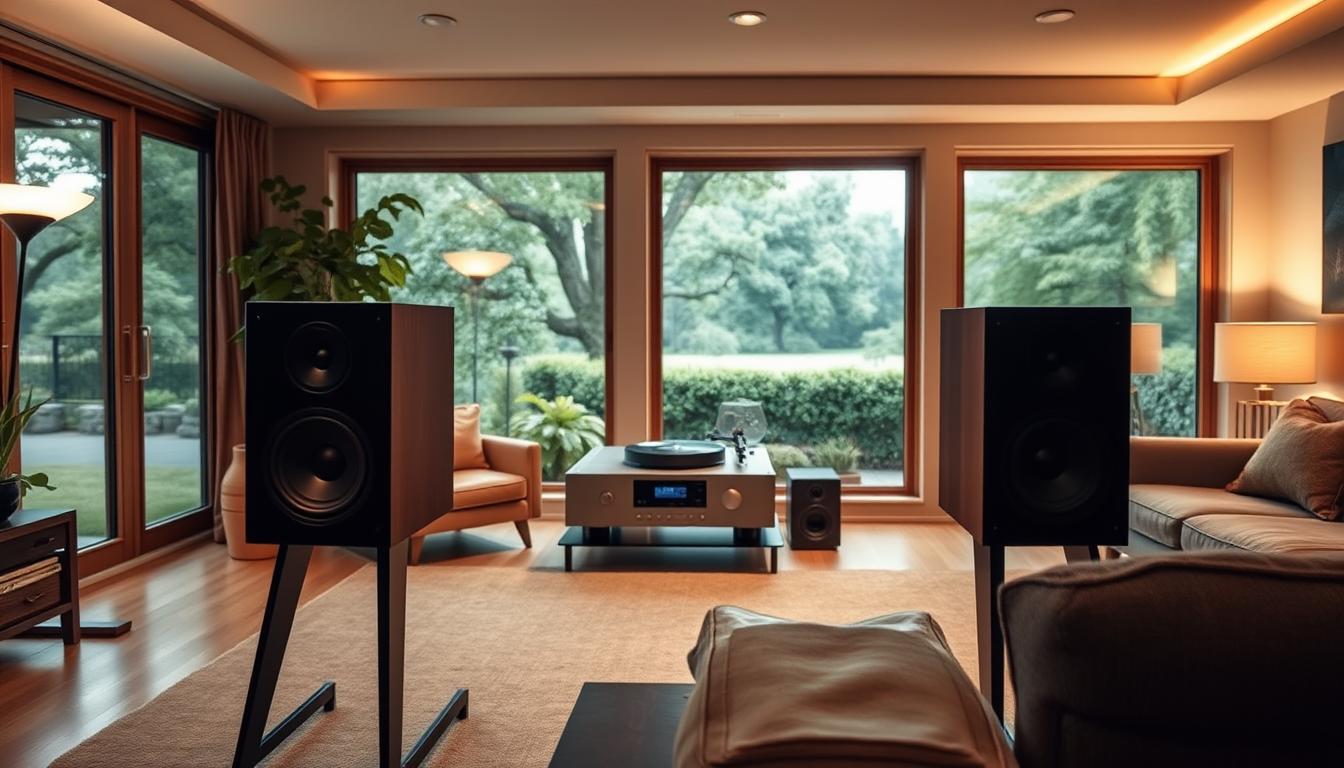
Why Speaker Placement Matters
Your listening position is crucial for achieving balanced sound. When your ears are aligned with the speakers, you experience accurate stereo imaging and depth. This direct relationship ensures that sound reaches you as intended, without distortion or loss of detail.
Room characteristics, such as size and shape, also influence sound quality. For example, placing speakers too close to a wall can amplify bass, but it may muddy the midrange. Understanding these dynamics helps you create a setup tailored to your space.
Overview of the Guide
This guide will walk you through practical techniques to optimize your speaker setup. We’ll cover:
- How reflections and wall distances affect sound.
- The importance of your listening position and ear alignment.
- Methods to control spatial dynamics for a balanced audio experience.
Forget confusing manual instructions. Instead, focus on strategies that work for your unique room. By the end, you’ll have the tools to transform your home audio system into a powerhouse of immersive sound.
Understanding Speaker Dispersion and Frequency Response
Sound dispersion and frequency behavior are key to achieving balanced audio. When your speakers emit sound, different frequencies behave in unique ways. Highs tend to travel in a focused pattern, while bass radiates more omnidirectionally. This affects how sound interacts with your room and ultimately reaches your ears.

High frequencies are directional, meaning they project forward in a narrow beam. This creates precise imaging but can lead to uneven sound if not properly aligned. Midrange frequencies spread wider, filling the room with clarity. Bass, on the other hand, disperses in all directions, making it less dependent on placement but more influenced by room acoustics.
How Highs, Mids, and Bass Behave
Highs are sharp and detailed, but they can reflect off surfaces, causing tonal imbalances. Mids carry the bulk of vocals and instruments, so their even distribution is crucial. Bass frequencies, while powerful, can build up in corners or cancel out in certain spots, creating peaks and nulls.
Understanding these behaviors helps you position your speakers for optimal performance. For example, placing speakers too close to walls can amplify bass but muddy the mids. Proper alignment ensures all frequencies are balanced, delivering a rich and immersive listening experience.
The Role of Speaker Design in Sound Projection
Speaker design plays a significant role in how sound is projected. Components like tweeters, woofers, and enclosures are engineered to control dispersion patterns. For instance, tweeters are designed to focus highs, while woofers handle the broader spread of bass.
Modern speakers often feature variable dispersion technology, allowing you to adjust horizontal and vertical angles for tailored sound coverage. This flexibility helps mitigate unwanted reflections and ensures consistent sound pressure levels across your room.
By understanding frequency response and dispersion, you can optimize your setup to match your space. This technical foundation sets the stage for addressing reflections and fine-tuning your audio system in later sections.
Rethinking Conventional Speaker Manual Advice
Many audio enthusiasts struggle with conflicting advice from speaker manuals. These guides often provide rigid rules that don’t account for unique room dynamics. This can lead to frustration, especially in smaller or irregularly shaped spaces.
Traditional manuals frequently suggest keeping speakers far from the wall. While this works in some setups, it’s not a one-size-fits-all solution. Blindly following this advice can create more problems than it solves.

Common Misconceptions About Wall Distance
One major misconception is that placing speakers close to a wall always ruins sound quality. In reality, this depends on your room’s acoustics. For example, in small spaces, moving speakers away from the wall can leave you with a hollow, unbalanced sound.
Another issue is the lack of flexibility in manuals. They often fail to address how reflections and room shape impact sound. This rigid approach can make it harder to achieve the best listening experience.
Here are some practical considerations to keep in mind:
- Use your ears as the ultimate guide. If it sounds good, it probably is.
- Experiment with placement based on your room’s unique characteristics.
- Don’t be afraid to break traditional rules if it improves your setup.
Rethinking placement based on room acoustics is key. Generic rules can’t account for every variable. By focusing on your space and listening preferences, you can create a setup that truly works for you.
Deciphering Acoustic Reflections and Boundary Interference
Acoustic reflections and boundary interference are often overlooked but critical to sound quality. When sound waves bounce off walls, floors, or ceilings, they interact with direct sound, altering frequency response. This can lead to an uneven or “colored” tonal balance, reducing clarity and immersion.

Understanding Comb Filtering Effects
Comb filtering occurs when direct and reflected sound waves overlap. This creates peaks and dips in frequency response, especially in the low-frequency range. For example, a reflection from a side wall can cause a dip at 150Hz, muddying bass performance.
The time delay between direct and reflected sound determines the severity of this effect. Longer delays result in more pronounced comb filtering, which can distort your audio experience.
How Boundary Interference Colors Your Sound
Boundary interference happens when sound waves reflect off surfaces like walls or floors. These reflections can either boost or cancel out certain frequencies, depending on their phase relationship. For instance, in-phase reflections amplify sound, while out-of-phase ones create dips.
Managing these effects is crucial for balanced sound. Here’s a quick summary of how reflections impact frequency response:
| Reflection Source | Effect on Frequency |
|---|---|
| Side Wall | Creates dips at specific low frequencies |
| Front Wall | Amplifies bass, but may muddy mids |
| Ceiling | Alters high-frequency clarity |
To minimize these issues, experiment with speaker placement. Moving your setup even a few inches can reduce unwanted reflections and improve sound quality. By understanding and managing these acoustic phenomena, you can achieve a clearer, more balanced audio experience in your room.
Leveraging the Triangle Method for Optimal Setup
The triangle method is a game-changer for achieving balanced sound in your space. This approach simplifies the process of positioning your audio equipment, ensuring an immersive listening experience. By focusing on geometric principles, you can unlock the full potential of your setup.
At its core, the triangle method involves forming an equilateral triangle between your speakers and your listening position. This arrangement ensures that sound reaches your ears evenly, enhancing stereo imaging and depth. It’s a straightforward yet effective way to optimize your room’s acoustics.
Forming the Ideal Equilateral Triangle
To create the ideal setup, place your speakers and listening position at equal distances. This geometric alignment ensures balanced sound distribution. For example, if your speakers are 8 feet apart, your seat should also be 8 feet from each speaker.
This method offers several benefits. It minimizes phase issues and ensures consistent sound pressure levels across your listening area. Experts and users alike praise its simplicity and effectiveness in achieving clear, immersive audio.
Experimentation is key. Adjust the distances slightly to suit your room’s unique characteristics. For more advanced setups, like Dolby Atmos ceiling speakers, the triangle method can serve as a foundation for further optimization.
By adhering to this approach, you can simplify the placement process and enjoy a more refined audio experience. Trust your ears and make adjustments as needed to achieve the best results.
Exploring Speaker Port Characteristics and Room Control Techniques
Understanding how speaker ports interact with your space can elevate your audio experience. Ports play a critical role in airflow and tuning, directly impacting low-frequency performance. Whether your speaker is front-ported, rear-ported, or sealed, each design has unique characteristics that influence sound quality.

Front-ported designs allow closer placement to walls, enhancing bass projection. Rear-ported models, on the other hand, require more space to prevent muddiness. Sealed speakers offer a balanced approach, eliminating port-related issues but often requiring additional amplification for deep bass.
Room control techniques are essential for optimizing performance. Proper spacing around the port ensures smooth airflow, reducing distortions like “chuffing.” For rear-ported speakers, maintaining a distance of at least 1-2 feet from walls minimizes boundary interference, preserving the speaker‘s design intent.
Here are practical tips to maximize your setup:
- Ensure sufficient clearance around ports for unobstructed airflow.
- Experiment with positioning to find the sweet spot for bass response.
- Use room treatments to manage reflections and enhance clarity.
Balancing technical specifications with actual listening results is key. While manufacturer guidelines provide a starting point, your room‘s unique acoustics may require adjustments. Trust your ears and make small changes to achieve the best sound.
By leveraging these techniques, you can create a setup that delivers optimal performance. Whether you’re fine-tuning bass or managing reflections, understanding port characteristics and room control ensures a superior listening experience.
Tackling Front Wall Reflections and Side Wall Impacts
Reflections from your walls can significantly alter the sound quality of your audio system. When sound waves bounce off surfaces like the front wall or side wall, they interact with direct sound, creating comb filtering and frequency dips. This can muddy bass response and disrupt stereo imaging, reducing clarity and immersion.

Managing Unwanted Reflections
Front wall reflections often amplify bass but can muddy midrange frequencies. Placing your speaker too close to the wall can cause low-end buildup, while too much distance may lead to a hollow sound. Side wall reflections, on the other hand, interfere with stereo imaging, making it harder to pinpoint sound sources.
Here are practical techniques to manage these issues:
- Evaluate reflection points relative to your listening position. Use the mirror trick to identify where sound bounces off walls.
- Use absorbers or diffusers to control reflections. Bass traps are particularly effective for managing low-frequency issues.
- Experiment with speaker placement. Even small adjustments can reduce unwanted reflections and improve sound quality.
Understanding how reflections impact your room is key to optimizing your setup. Here’s a summary of how different walls affect sound:
| Reflection Source | Effect on Sound |
|---|---|
| Front Wall | Amplifies bass, may muddy mids |
| Side Wall | Interferes with stereo imaging |
| Ceiling | Alters high-frequency clarity |
By addressing these reflections, you can achieve a clearer, more balanced audio experience. Trust your ears and make adjustments as needed to create the perfect setup for your room.
Harnessing Space Loading for Enhanced Bass Performance
Maximizing bass performance in your audio setup often hinges on understanding space loading. This phenomenon occurs when speakers placed near walls or corners gain extra low-frequency energy. By leveraging this effect, you can achieve deeper, more impactful bass in your room.

When you position your speaker close to a wall or corner, the boundary reinforces low frequencies. This is because sound waves reflect off the surface, adding to the direct output. In smaller rooms, this effect can be particularly pronounced, boosting bass by up to 9 dB per octave below certain frequencies.
However, space loading isn’t always beneficial. While it enhances bass, it can also lead to an unbalanced sound. For example, placing a speaker too close to the back wall may cause midrange frequencies to muddy, reducing clarity.
Here’s how to harness or mitigate space loading effectively:
- Experiment with placement: Move your speaker closer to or farther from walls to find the sweet spot for bass response.
- Use EQ adjustments: If bass becomes overwhelming, apply equalization to balance the low frequencies.
- Consider room treatments: Bass traps or absorbers can help manage excessive low-end buildup.
Understanding the acoustic principles behind boundary reinforcement is key. For instance, in a room with a longest dimension of 16 feet, space loading begins at 35 Hz. Below this frequency, bass levels increase significantly, enhancing your system’s performance.
By carefully managing space loading, you can achieve a powerful yet balanced bass response. Trust your ears and make small adjustments to optimize your setup for your unique space.
Divide and Conquer: Simplifying the Placement Challenge
Simplifying speaker placement can feel overwhelming, but breaking it into smaller steps makes it manageable. The “divide and conquer” strategy helps you tackle complex setup challenges by focusing on one aspect at a time. This approach ensures you don’t miss critical details while achieving balanced sound in your room.

Step-by-Step Listening Tests
Start by conducting systematic listening tests. Move your speaker to different positions and evaluate the sound quality at each point. This method helps isolate problematic reflections and imbalances. Trust your ears to guide you toward the best setup.
Here’s how to perform these tests effectively:
- Begin with your speaker in a neutral position. Play a track with a wide frequency range.
- Move the speaker incrementally, testing each new spot. Pay attention to bass clarity, midrange detail, and high-frequency precision.
- Take notes on how each adjustment affects the sound. This helps you track changes and identify the optimal position.
By breaking the process into smaller steps, you can focus on specific issues. For example, if bass feels muddy, adjust the distance from the wall. If stereo imaging is unclear, tweak the angle of the speaker.
Here’s a summary of key adjustments and their effects:
| Adjustment | Effect on Sound |
|---|---|
| Distance from Wall | Improves bass clarity or reduces muddiness |
| Angle of Speaker | Enhances stereo imaging and depth |
| Height Placement | Balances high-frequency response |
Iterate through these steps until you achieve the best sound. Remember, your room is unique, so trust your ears and make adjustments that suit your space. This systematic approach ensures a refined and immersive audio experience.
Personalizing Your Setup: Trusting Your Ears
Your ears are the ultimate judge when it comes to optimizing your audio setup. While technical guidelines provide a foundation, personalizing your speaker placement ensures the best sound for your unique room. Trusting what you hear is key to achieving clarity and immersion.
Discovering the Phantom Speaker Test
The Phantom Speaker Test is a powerful tool for fine-tuning your setup. This method involves playing a mono audio track and adjusting your speaker placement until the sound appears to come from a central point, or “phantom” image. This ensures balanced stereo imaging and precise sound localization.
Here’s how to perform the test effectively:
- Play a mono track with vocals or instruments.
- Adjust the toe-in angle of your speakers slightly inward or outward.
- Move your listening position forward or backward to find the sweet spot.
Subtle adjustments can make a significant difference. For example, increasing the toe-in angle directs sound more precisely toward your ears, enhancing detail and clarity. Experimentation is essential, as no two rooms are the same.
Controlled Listening Sessions
Conducting controlled listening sessions helps refine your setup. Play a variety of tracks, from bass-heavy music to dialogue-rich movies, to evaluate different frequencies. Take notes on how each adjustment affects the sound, focusing on bass response, midrange clarity, and high-frequency detail.
Here’s a summary of key adjustments and their effects:
| Adjustment | Effect on Sound |
|---|---|
| Toe-In Angle | Enhances stereo imaging and detail |
| Distance from Wall | Improves bass clarity or reduces muddiness |
| Height Placement | Balances high-frequency response |
Trust your ears and make small changes to achieve the best sound. By personalizing your setup, you can create an audio experience that truly resonates with you.
Formulas and Methods: Cardas and Audio Physic Approaches
Achieving the best sound in your room often requires a blend of science and precision. Two renowned approaches, Cardas and Audio Physic, offer mathematical formulas and room mapping techniques to optimize speaker placement. These methods ensure balanced frequency response and minimize acoustic issues.
Using the Golden Ratio and Room Mapping
Cardas’ Golden Ratio is a scientific method that minimizes node interaction. It uses specific formulas to calculate the ideal distance from walls. For example, the distance from the center of the woofer to the side walls is calculated as RW x 0.276, while the back wall distance is RW x 0.447.
Audio Physic takes a different approach with room mapping. This method divides the room into even sections to optimize bass reinforcement. By placing speakers at two center points of an ellipsoid, it ensures psycho-acoustic timing and balanced sound distribution.
Both methods emphasize the importance of precise measurements. For instance, Cardas’ formula might place speakers 44.25 inches from side walls and 73.5 inches into the room. Audio Physic’s approach could result in speakers 37 inches from side walls and 72-73 inches from the rear wall.
Here’s a summary of key differences between the two approaches:
| Method | Key Feature | Result |
|---|---|---|
| Cardas | Golden Ratio formulas | Minimizes node interaction |
| Audio Physic | Room mapping and ellipsoid placement | Optimizes bass reinforcement |
Applying these technical methods alongside listening tests ensures the best results. Trust your ears to fine-tune the setup, especially when playing music or evaluating frequency response. By combining science and personal preference, you can create an immersive audio experience tailored to your room.
Adapting Techniques for Home Studio Constraints
Small spaces like home studios or dorms often present unique challenges for speaker placement. Limited square footage, awkward layouts, and aesthetic considerations can make it difficult to achieve optimal sound. However, with a few adjustments, you can still create a high-quality audio setup.
One common issue in tight spaces is wall proximity. Placing speakers too close to walls can amplify bass, but it may muddy midrange frequencies. To counter this, experiment with positioning. Even a few inches can make a difference. For example, moving your speaker 6-12 inches away from the wall can improve clarity.
Here are some practical tips for adapting proven techniques to small rooms:
- Use vertical space: Mount speakers on stands or shelves to free up floor space and position tweeters at ear level.
- Minimize reflections: Use absorbers or diffusers on walls to control unwanted echoes and improve sound quality.
- Experiment with angles: Slight toe-in adjustments can enhance stereo imaging in compact setups.
Aesthetic and logistical constraints are also common in home studios. For instance, you might need to position speakers near furniture or equipment. In such cases, prioritize functionality without compromising sound. A well-placed bass trap or acoustic panel can mitigate placement compromises.
Even in constrained spaces, effective placement can greatly enhance performance. Customize your setup to fit your unique room and listening habits. Trust your ears and make small adjustments to achieve the best sound for your personal space.
Designing the Perfect Speaker Placement: Key Techniques
Achieving the best audio experience in your space relies on mastering a few essential techniques. Throughout this guide, we’ve explored strategies to optimize your setup. Now, let’s consolidate these insights into actionable steps for superior sound quality.
Start by focusing on the triangle method. This approach ensures balanced sound by forming an equilateral triangle between your speakers and your listening position. It’s a simple yet effective way to enhance stereo imaging and depth.
Next, manage reflections to minimize unwanted distortions. Use absorbers or diffusers on walls to control echoes. For example, placing bass traps in corners can reduce low-frequency buildup, improving clarity.
Here’s a quick checklist to guide your placement:
- Ensure symmetry in positioning for balanced sound.
- Experiment with toe-in angles to refine stereo imaging.
- Maintain a minimum distance of 1-2 feet from walls to reduce early reflections.
Adjustments like these can yield excellent results. For instance, moving your speaker even a few inches can significantly improve bass clarity. Trust your ears to fine-tune the setup for your unique room.
Here’s a summary of key adjustments and their effects:
| Adjustment | Effect on Sound |
|---|---|
| Distance from Wall | Improves bass clarity or reduces muddiness |
| Toe-In Angle | Enhances stereo imaging and detail |
| Height Placement | Balances high-frequency response |
By applying these techniques, you can create a setup that delivers rich, dynamic sound. Whether you’re fine-tuning bass or managing reflections, these strategies ensure an immersive audio experience tailored to your space.
Conclusion
Getting the most out of your audio setup requires a mix of technique and personal touch. Throughout this guide, we’ve explored methods like the triangle approach and managing reflections to enhance sound quality. The key takeaway? Trust your ears and experiment with placement to find what works best for your room.
Effective speaker setup isn’t about rigid rules. It’s about balancing technical strategies with your unique listening preferences. Take the time to adjust your system, and you’ll enjoy a more immersive and balanced sound experience.
Combining proven methods with personal tweaks yields the best result. Whether you’re fine-tuning bass or managing reflections, small changes can make a big difference. Share your experiences and continue refining your setup for even better performance.
Ready to elevate your audio? Start experimenting today and discover the way to unlock your system’s full potential.
FAQ
Why does speaker placement matter in a home audio system?
Proper speaker placement ensures balanced sound distribution, minimizes unwanted reflections, and enhances bass performance. It directly impacts your listening experience by improving clarity and stereo imaging.
How do highs, mids, and bass behave in a room?
High frequencies are directional and travel in straight lines, while mids and bass disperse more widely. Bass waves can interact with walls and corners, creating peaks or nulls in the frequency response.
What is the triangle method for speaker setup?
The triangle method involves placing your speakers and listening position to form an equilateral triangle. This setup ensures balanced stereo imaging and optimal soundstage.
How can I manage front and side wall reflections?
Use acoustic treatments like absorbers or diffusers to reduce reflections. Positioning speakers away from walls and experimenting with toe-in angles can also minimize unwanted sound coloration.
What is space loading, and how does it affect bass?
Space loading refers to how bass frequencies interact with room boundaries. Placing speakers near walls or corners can boost bass, but it may also lead to uneven frequency response.
How do I perform a listening test for speaker placement?
Play familiar music tracks and adjust speaker positions while listening for clarity, imaging, and bass balance. Small changes can make a significant difference in sound quality.
What is the phantom speaker test?
The phantom speaker test involves playing a mono audio track to check if the sound appears to come from a central point between the speakers. This indicates proper stereo imaging.
How can I use the golden ratio for speaker placement?
The golden ratio helps determine optimal speaker distances from walls. For example, place speakers at 38% of the room’s length from the front wall to reduce standing waves and improve sound clarity.
What are common misconceptions about wall distance for speakers?
Many believe speakers should always be placed close to walls for better bass. However, this can cause boomy or muddy sound. Experimenting with distance is key to finding the sweet spot.
How do I adapt speaker placement for a home studio?
In a home studio, prioritize symmetry and minimize reflections. Use acoustic panels and position speakers at ear level to achieve accurate monitoring for mixing and recording.