Did you know that the design of your subwoofer enclosure can impact bass response by up to 50%? Whether you’re an audiophile or a casual listener, crafting the perfect box for your speaker is essential for achieving deep, rich sound.
Using quality materials like wood or MDF ensures durability and optimal acoustics. Proper assembly with panels, glue, and precise measurements guarantees airtight joints, preventing sound leaks. Attention to depth and internal volume is critical from the start.
This guide provides step-by-step instructions to help you create a high-performance enclosure. From selecting the right board to final installation, every detail is covered. With the right tools and techniques, you’ll achieve a durable, professional-grade setup.
Key Takeaways
- Proper design ensures optimal bass response and sound quality.
- Quality materials like wood and MDF enhance durability and acoustics.
- Precise measurements for depth and volume are crucial.
- Airtight assembly prevents sound leaks and improves performance.
- Step-by-step instructions simplify the process for beginners.
Understanding the Fundamentals of Subwoofer Enclosures
The foundation of great bass lies in the design of your subwoofer enclosure. It’s not just a box to house your speaker—it’s a critical component that shapes sound quality and performance.

The Purpose of an Enclosure
An enclosure serves two main roles. First, it improves bass response by controlling the movement of the driver. Without it, the speaker can suffer from over-excursion, leading to distortion or damage.
Second, it aligns with manufacturer recommendations for optimal performance. Each subwoofer has specific requirements for internal volume and dimension. Meeting these ensures your setup delivers the best sound possible.
Advantages of Proper Enclosure Design
A well-designed box enhances sound quality by preventing unwanted cancellations. It also protects the driver, ensuring it operates efficiently over time.
Key factors include airtight construction and precise internal volume. These elements make sure the enclosure performs as intended, delivering deep, clear bass.
| Feature | Benefit |
|---|---|
| Airtight Construction | Prevents sound leaks and distortion |
| Proper Internal Volume | Aligns with manufacturer specs for optimal bass |
| Accurate Dimensions | Ensures the driver operates efficiently |
Understanding these fundamentals helps you make informed decisions during the build process. Whether you’re working with a sealed or ported box, the right design ensures your subwoofer performs at its best.
Exploring Various Enclosure Types
Choosing the right enclosure type can transform your bass experience. Each design offers unique benefits and trade-offs, making it essential to understand their characteristics. Whether you prioritize deep bass, tight response, or efficiency, the right box can elevate your sound system.

Infinite Baffle, Sealed, Ported, and Bandpass Explained
Infinite baffle enclosures use the vehicle’s trunk as part of the design. They require minimal space but need proper sealing to prevent sound leaks. These setups are ideal for those seeking a natural bass response without a bulky box.
Sealed enclosures are known for their tight, accurate bass. They are airtight, ensuring the driver operates efficiently. This type is perfect for music genres that demand precision, like jazz or classical.
Ported enclosures emphasize low bass response. A tuned port enhances volume at specific frequencies, making them louder than sealed designs. However, they require careful tuning to avoid distortion.
Bandpass enclosures focus on a narrow frequency range, delivering pronounced bass within that band. They are complex to design but can produce impressive output for specific music styles.
| Enclosure Type | Benefits | Drawbacks |
|---|---|---|
| Infinite Baffle | Natural bass, space-saving | Requires proper sealing |
| Sealed | Tight, accurate bass | Less efficient at low frequencies |
| Ported | Louder bass, enhanced low frequencies | Complex tuning required |
| Bandpass | Pronounced bass in specific range | Limited frequency response |
Following manufacturer specifications ensures your enclosure aligns with the woofer’s requirements. Proper dimension and internal volume are critical for optimal performance. Tailoring your choice to your music preferences and vehicle space guarantees a satisfying listening experience.
How to Build a Custom Wooden Subwoofer Enclosure
Crafting a high-performance subwoofer setup starts with a solid plan. A clear understanding of the steps involved ensures your enclosure delivers exceptional sound quality. From design to final assembly, each step plays a crucial role in the success of your project.

Overview of the Build Process
The first step is planning your box. Start by determining the internal volume and dimensions based on your subwoofer’s specifications. This ensures optimal bass response and prevents fitment issues.
Next, gather quality materials like wood or MDF. These materials are durable and provide excellent acoustics. You’ll also need tools such as a saw, drill, and measuring tape for precise cuts and assembly.
- Design: Sketch your enclosure with accurate measurements.
- Material Selection: Choose MDF or plywood for durability and sound quality.
- Assembly: Use screws and glue to create airtight joints.
- Safety: Wear protective gear and work in a well-ventilated area.
Once the panels are cut, assemble them carefully. Use glue to seal the joints and reinforce them with screws. This ensures a rigid and airtight construction, which is essential for optimal performance.
Finally, test your enclosure before final installation. Check for air leaks and ensure the driver fits perfectly. Following these steps guarantees a professional-grade setup that enhances your listening experience.
Design Considerations and Dimension Planning
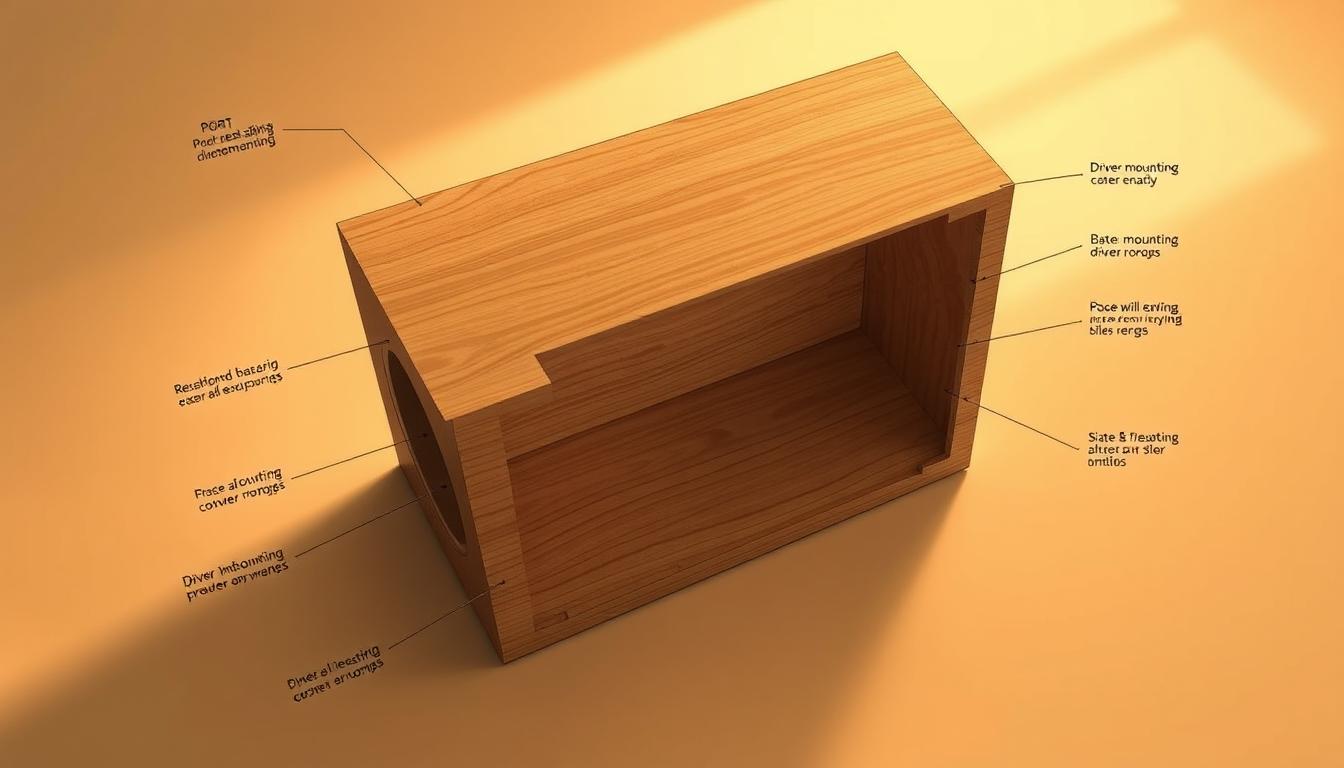
Accurate planning is the backbone of a successful subwoofer setup. Before diving into the build, it’s essential to measure the available space in your vehicle. This ensures your enclosure fits perfectly without compromising functionality.
Calculating Available Space in Your Vehicle
Start by measuring the area where the box will be placed. Use a tape measure to determine the length, width, and height in foot or inch units. Consider obstacles like seats or wheel wells that could affect the dimension.
Once you have the measurements, subtract a small amount to account for padding or mounting hardware. This ensures a snug fit while leaving room for adjustments. Proper planning prevents last-minute issues during installation.
Determining Optimal Dimensions for Bass Response
The internal volume of your enclosure directly impacts bass performance. Larger enclosures typically produce deeper bass, while smaller ones offer tighter, more controlled sound. Refer to your driver’s specifications for recommended volume.
Use the formula Length x Width x Height to calculate the internal dimension. For example, a box measuring 2 ft x 1.5 ft x 1 ft equals 3 cubic feet. Ensure the size aligns with your vehicle’s space and your subwoofer’s requirements.
Balancing physical space and driver excursion limits is crucial. A well-planned enclosure delivers outstanding sound performance, enhancing your listening experience.
Materials and Tools for Your Project
The right materials and tools are essential for crafting a durable and high-performing subwoofer enclosure. Quality choices ensure the box is rigid, airtight, and acoustically optimized. Whether you’re a beginner or an experienced builder, selecting the correct components makes the process smoother and the results more professional.
Choosing Quality Wood: MDF and Alternatives
Medium-density fiberboard (MDF) is a popular choice for subwoofer enclosures. Its density of approximately 40-50 lbs per cubic foot provides excellent acoustic properties. MDF is easy to work with and resists warping, making it ideal for creating airtight panels.
If MDF isn’t available, plywood is a viable alternative. While slightly less dense, it offers good strength and durability. Avoid particleboard, as it lacks the rigidity needed for a high-performance box.
Essential Tools for Cutting and Assembly
Having the right tools ensures precision and efficiency. A table saw or circular saw is essential for cutting panels to size. A jigsaw is useful for creating speaker cutouts and other detailed work.
For assembly, a power drill and drywall screws are necessary. Use 1/2″ to 1 3/4″ sheet metal screws for secure fastening. Combine glue with screws to create durable, airtight joints. An air nailer can also speed up the process while maintaining strength.
- Material Selection: Choose MDF or plywood for durability and sound quality.
- Tools: Table saw, jigsaw, power drill, and air nailer are essential.
- Assembly: Use glue and screws for airtight construction.
By using quality materials and the right tools, you’ll create a subwoofer enclosure that delivers exceptional sound and lasts for years.
Construction Techniques for Strength and Sound Integrity
The quality of your bass relies heavily on the construction of your enclosure. A well-built box ensures your speaker delivers powerful, distortion-free sound. Rigid walls and airtight joints are essential for optimal performance.

Ensuring Rigid, Airtight Walls
Flexing in the enclosure can lead to sound cancellation and reduced bass response. To prevent this, use materials like MDF or plywood for their density and rigidity. These materials minimize vibrations and maintain structural integrity.
Sealing joints is equally important. Apply glue along the edges before securing panels with screws. For added airtightness, use silicone caulk to seal any gaps. This prevents air leaks, which can degrade sound quality by up to 30%.
Reinforcing panels further enhances strength. Internal bracing reduces standing waves and improves sound clarity. This technique also prevents the box from flexing, ensuring consistent bass output.
| Technique | Benefit |
|---|---|
| Rigid Walls | Prevents flexing and sound cancellation |
| Airtight Joints | Eliminates air leaks for optimal bass |
| Internal Bracing | Reduces vibrations and improves clarity |
Proper construction techniques yield a durable enclosure with impeccable sound quality. By focusing on rigidity and airtightness, you’ll achieve a setup that delivers deep, clear bass every time.
Step-by-Step Assembly Instructions
Assembling a subwoofer enclosure requires precision and attention to detail. Each step ensures the box is airtight, durable, and acoustically optimized. Follow these instructions to achieve a professional-grade build.
Panel Assembly and Gluing Methods
Start by aligning the panels according to your design. Apply glue evenly along the edges of each piece. This creates a strong bond and prevents air leaks. Use clamps to hold the panels in place while the glue dries.
For the bottom and top sections, ensure they fit snugly with the sides. Double-check measurements to avoid gaps. A well-aligned enclosure ensures structural integrity and optimal sound performance.
Using Screws and Caulk to Seal Joints
Once the glue is set, reinforce the joints with screws. Pre-drill holes to prevent splitting the board. Secure each panel with at least two screws for added stability.
Next, apply caulk along the internal seams. This step eliminates air leaks, which can degrade sound quality. Smooth the caulk with a finger or tool for a clean finish.
| Step | Purpose |
|---|---|
| Apply Glue | Creates a strong bond between panels |
| Use Screws | Reinforces joints for added durability |
| Seal with Caulk | Prevents air leaks for optimal sound |
By following these steps, you’ll create a rigid and airtight enclosure. Precision at each stage ensures your box delivers deep, clear bass without distortion.

Test the enclosure before final installation. Check for gaps or loose screws. A well-built box enhances your listening experience and lasts for years.
Integrating Amplifiers and Wiring Considerations
Amplifiers and wiring play a crucial role in achieving clear, powerful bass from your subwoofer setup. Proper integration ensures your enclosure delivers optimal sound performance. Whether you’re a beginner or an experienced builder, understanding these elements is essential.
Proper Wiring Methods for Clear Sound
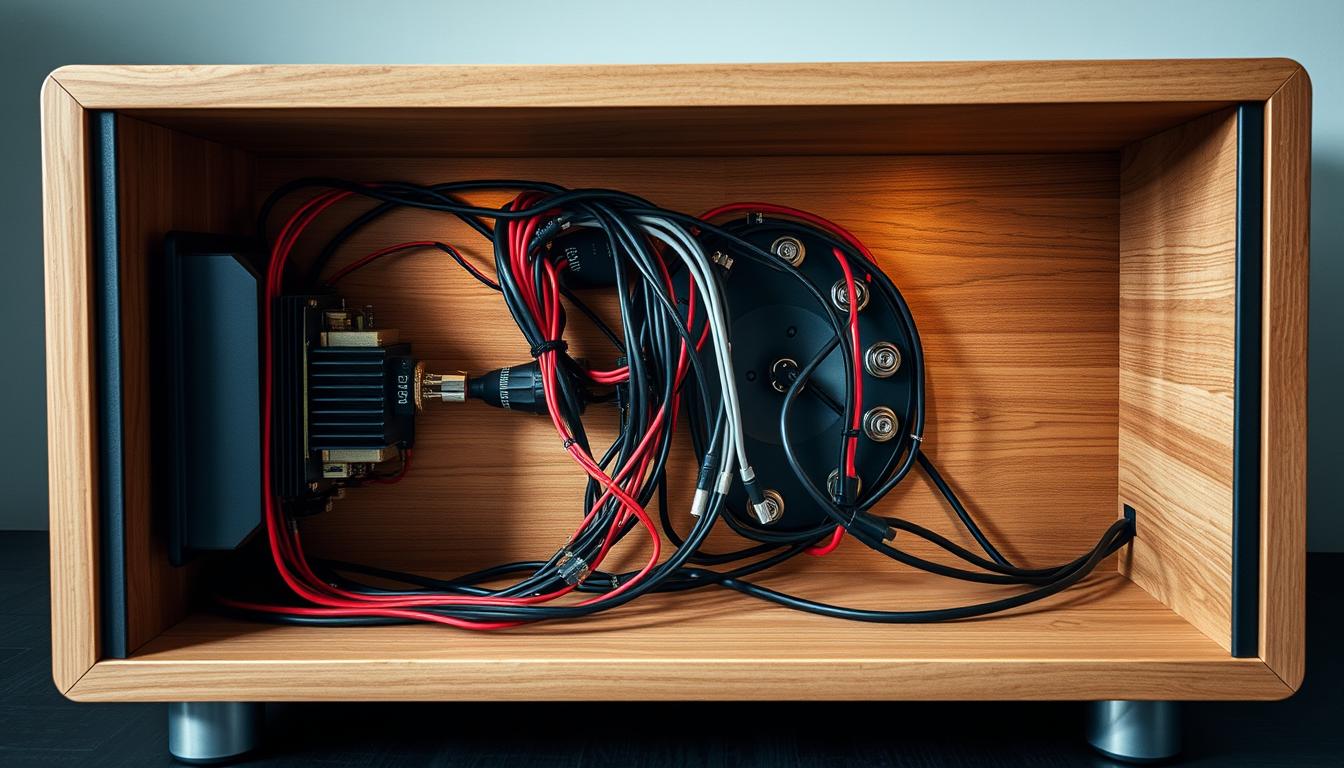
Start by selecting high-quality wire that matches your amplifier’s power output. Thicker gauge wires reduce resistance, ensuring efficient power transfer. This prevents distortion and protects your speaker from damage.
Route the wire neatly inside the box to avoid interference. Keep power and signal cables separate to minimize noise. Use cable ties or clips to secure the wiring, ensuring it doesn’t interfere with the woofer’s movement.
Connectors are equally important. Choose gold-plated terminals for better conductivity and corrosion resistance. Secure connections prevent signal loss, ensuring your enclosure performs at its best.
Amplifier Integration for Optimal Performance
Match your amplifier’s power output to your subwoofer’s specifications. Overpowering or underpowering can lead to distortion or damage. Place the amplifier in a well-ventilated area to prevent overheating.
Connect the amplifier to the box using high-quality cables. Ensure the polarity is correct to avoid phase issues. A well-integrated amplifier enhances bass response, delivering deep, clear sound.
Troubleshooting Common Wiring Issues
If you experience sound issues, check for loose connections or damaged wire. Test the continuity of your cables using a multimeter. Ensure the amplifier’s settings align with your subwoofer’s requirements.
Proper wiring and amplifier integration are key to maximizing your enclosure’s performance. By following these steps, you’ll achieve a setup that delivers exceptional sound quality.
Optimizing subwoofer placement can further enhance sound quality, especially when paired with proper wiring and amplifier setup. For more tips, check out this guide on optimizing subwoofer placement.
Troubleshooting and Overcoming Build Challenges
Even the most experienced builders can face challenges when creating a subwoofer enclosure. Identifying and resolving these issues ensures your box delivers optimal sound quality. From flexing walls to air leaks, addressing these problems early saves time and effort.
Preventing Flexing and Air Leaks
Flexing in the enclosure can distort bass output. To prevent this, use rigid materials like MDF or plywood. These materials minimize vibrations and maintain structural integrity. Reinforce the box with internal bracing to reduce standing waves.
Air leaks are another common issue. Apply silicone caulk along all seams to seal gaps. This ensures airtight construction, which is critical for clear, distortion-free bass. Test the enclosure by pressing on the walls; any movement indicates the need for reinforcement.
Addressing Common Mistakes in Assembly
Misaligned panels can compromise the dimension and performance of your box. Double-check measurements before cutting and assembling. Use clamps to hold panels in place while the glue dries.
Incorrect screw placement can weaken the structure. Pre-drill holes to avoid splitting the material. Secure each joint with at least two screws for added stability. Ensure the speaker fits perfectly by testing the cutout before final assembly.
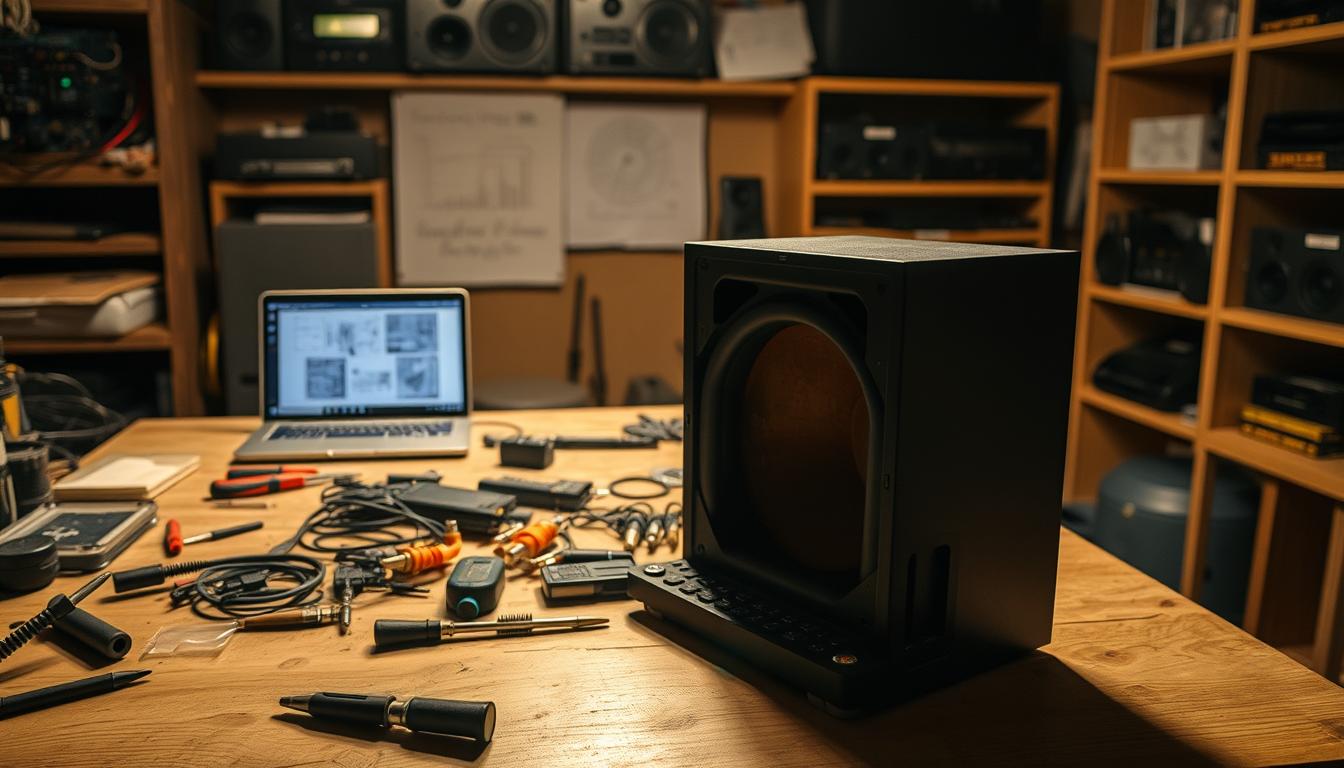
If you encounter issues, recalibrate the dimensions to match your speaker’s requirements. Small adjustments can make a big difference in sound quality. Always test the enclosure for leaks and structural integrity before installation.
By addressing these challenges, you’ll create a durable and high-performing enclosure. Careful review during assembly helps avoid costly and time-consuming errors, ensuring your setup delivers exceptional bass.
Optimizing Sound Quality Through Proper Tuning
Fine-tuning your subwoofer enclosure can unlock its full potential. The right adjustments ensure your bass is deep, clear, and distortion-free. Whether you’re a beginner or an experienced builder, these steps will help you achieve optimal sound performance.

Understanding Bass Frequency Responses
Bass frequency response is the thing that defines how your enclosure handles low-end sounds. A well-tuned box ensures the driver operates efficiently, delivering punchy bass without distortion. Matching the enclosure’s characteristics to your subwoofer’s specifications is critical.
For example, a sealed box provides tight, accurate bass, while a ported design emphasizes low frequencies. Testing different music tracks helps evaluate performance across various frequencies. This step ensures your setup delivers the best sound for your listening preferences.
Adjusting Enclosure Parameters for Best Output
Small changes in internal volume or panel stiffness can significantly impact sound quality. Increasing the volume by 20% can enhance efficiency, but exceeding this may lead to diminishing returns. Use caulk to seal gaps and prevent air leaks, which can reduce bass output by up to 20%.
Tools like WinISD help calculate the ideal dimensions and tuning frequency for your enclosure. Internal bracing reduces standing waves, improving clarity. These adjustments ensure your box performs at its best, delivering deep, powerful bass.
“Proper tuning transforms a good enclosure into a great one. It’s the difference between muddy bass and crystal-clear sound.”
By following these steps, you’ll optimize your enclosure for exceptional sound quality. Take the time to test and refine your setup, and you’ll enjoy a listening experience that hits all the right notes.
Advanced Customization and Design Enhancements
Taking your subwoofer setup to the next level involves more than just functionality—it’s about making it uniquely yours. Advanced customization allows you to blend performance with personal style, creating an enclosure that stands out both visually and acoustically.
Personalizing Your Enclosure for Aesthetic Appeal
Custom finishes can transform your box into a centerpiece. Consider painting the surface with automotive-grade paint for a sleek, professional look. Alternatively, vinyl wraps offer endless color and pattern options, allowing you to match your speaker setup to your vehicle’s interior.
Adding artistic touches like laser-etched designs or decals can further enhance the design. These elements not only reflect your personality but also elevate the overall appearance of your enclosure.
Integrating Functional and Stylish Features
Custom grills are a popular choice for both protection and style. Choose from materials like metal or mesh to complement your box. Some grills even feature RGB lighting, adding a dynamic visual element to your setup.
Internal enhancements, such as LED strips, can illuminate the enclosure from within. This not only looks impressive but also highlights the craftsmanship of your build. Ensure these additions don’t interfere with the speaker’s performance by keeping wiring neat and secure.
Balancing Aesthetics and Acoustics
While personalizing your box, it’s crucial to maintain sound quality. Avoid overcrowding the surface with heavy materials that could dampen bass response. Test any modifications to ensure they don’t compromise the enclosure’s acoustics.
For those seeking inspiration, explore acoustic treatment techniques that can enhance both sound and style. These methods ensure your setup remains functional while reflecting your unique taste.
By combining creativity with precision, you can create a subwoofer enclosure that’s as visually striking as it is powerful. Let your imagination guide you, and enjoy a setup that’s truly one-of-a-kind.
Conclusion
Creating a high-quality subwoofer setup requires attention to detail and precision. By focusing on accurate dimensions and airtight construction, you ensure your enclosure delivers deep, clear bass. Quality materials like MDF enhance durability and sound performance, while proper sealing with caulk prevents air leaks.
From planning to assembly, each step plays a crucial role. Reinforce joints with screws and glue for added strength. Test the box for leaks and ensure the driver fits perfectly. These efforts result in a professional-grade setup that enhances your listening experience.
With the right tools and techniques, you can craft an enclosure that meets both performance and aesthetic goals. Start your project today and enjoy the satisfaction of a custom-built subwoofer setup tailored to your vehicle and preferences.
FAQ
What is the purpose of a subwoofer enclosure?
A subwoofer enclosure enhances bass response by controlling air movement around the driver. It prevents sound waves from canceling each other out, ensuring deeper and clearer bass output.
What types of enclosures are available for subwoofers?
Common types include infinite baffle, sealed, ported, and bandpass enclosures. Each type offers unique sound characteristics, from tight and accurate bass to louder, more resonant tones.
Why is MDF a popular choice for building enclosures?
MDF (Medium-Density Fiberboard) is dense, affordable, and easy to work with. Its rigidity minimizes vibrations, ensuring a clean and distortion-free sound.
How do I determine the right dimensions for my enclosure?
Measure the available space in your vehicle and refer to the subwoofer manufacturer’s specifications. Optimal dimensions depend on the driver’s requirements and the desired bass response.
What tools are essential for building a wooden enclosure?
You’ll need a saw, drill, screws, wood glue, caulk, and clamps. These tools help ensure precise cuts, secure assembly, and airtight seals for better sound quality.
How can I prevent air leaks in my enclosure?
Use wood glue and screws to secure panels tightly. Apply caulk to seal joints and edges, ensuring the enclosure is completely airtight for optimal performance.
What wiring considerations are important for subwoofer integration?
Use high-quality wires and ensure proper connections to the amplifier. Correct wiring minimizes signal loss and interference, delivering clear and powerful bass.
How can I improve the sound quality of my enclosure?
Tune the enclosure by adjusting parameters like volume and port size. Experiment with placement in your vehicle to find the best bass response and sound clarity.
Can I customize the design of my enclosure?
Yes, you can personalize the shape, finish, and color to match your vehicle’s interior. Adding features like LED lighting or unique panel designs enhances aesthetic appeal.
What are common mistakes to avoid during assembly?
Avoid using weak materials, improper measurements, or insufficient sealing. These mistakes can lead to poor sound quality, flexing, or air leaks in the enclosure.